The New York State Assembly Says They Are Committed to Supporting Migrant Youth From Central America

Originally published on September 16, 2014

On Tuesday, September 16, the New York State Assembly Committee on Social Services and Standing Committee on Children and Families Task Force on New Americans held a public hearing with State agencies to address the influx of migrant youth from Central American countries and to examine the state’s role in caring for youth who enter the United States illegally through the southwestern border.

“Here in New York City, we are fully committed to supporting these children and their families,” said Nisha Argarwal, Commissioner to the Mayor’s Officer of Immigrant Affairs in New York City.

Federally-funded State agencies in New York try to provide these migrant youth with legal aid and special care services. However, these organizations struggle annually to receive proper funding from the government to give each migrant child sufficient educational, legal, and health services.

“By investing about $24 million dollars a year in these kids, we can assure their future and the future of New York State. They have potential to become our future and nobody has placed emphasis on investing their future,” said Monsignor Kevin Sullivan, Executive Director at Catholic Charities of the Diocese of New York, at Tuesday’s hearing.

The special service care providers and legal aid organizations present at the hearing agreed on the common notion that this issue starts with the whole young person and encouraged the assembly members to examine the funds allocated by the state in regards to helping these children.

“It is important for us to understand what is happening, to understand where to do better” said Member of NYC Assembly Marcus Crespo, “When you come down to it and when you see the faces of these innocent children…it really hits home.”
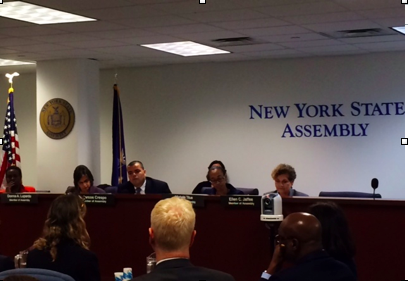
Photo // Charlotte Gibson The New York State Assembly holds a hearing to discuss the recent influx of migrant youth from Central America to New York City, on Tuesday, September 16, 2014.
Photo // Charlotte Gibson
The New York State Assembly holds a hearing to discuss the recent influx of migrant youth from Central America to New York City, on Tuesday, September 16, 2014.

East Harlem Locals and Activists Protest Luxury Tower Development Plan

Originally published on August 28, 2014

On Thursday evening, August 28th, approximately 80 East Harlem community members and activists gathered on the sidewalk of E. 118th Street and Pleasant Avenue to protest the recent plans of Blumenfeld Development Group and Forest City Ratner Companies to develop luxury towers atop the East River Plaza Mall.

Photo // Charlotte Gibson East Harlem locals gather on 118th Street and Pleasant Avenue to protest the recent development plans to build luxury towers atop East River Plaza.
Photo // Charlotte Gibson
East Harlem locals gather on 118th Street and Pleasant Avenue to protest the recent development plans to build luxury towers atop East River Plaza.

The assembly of locals and activists raised concerns that the development will drive out most of “El Barrio” friends and neighbors, displacing poor people and exclusively attracting the upper-middle class to the Pleasant Avenue neighborhood. The demonstrators, who led the protest with the slogan, “El Barrio Unite,” believe the luxury towers will interrupt the community’s class-structure, economic development, quality of life, and preservation of East Harlem. 

Demonstrators lined up along the sidewalk on Pleasant Avenue to stop Blumenfeld Development Group and Forest City Ratner Companies from continuing their plan to “segregate the neighborhood for economic growth,” says Roger Hernandez, a member of the East Harlem N.E.R.V.E. community housing group, “This is exclusionary displacement because it has to do with money.”

Hernandez, a native of East Harlem, believes the evening’s protests illustrate how the 50 story luxury towers are not an “anti-development piece based on race, the color of your skin,” but rather, “economic development.”

Blumenfeld Development Group and Forest City Ratner Companies first announced their proposal to build the 1,000 unit residential towers atop the East River Plaza mall in East Harlem to local community members at a East Harlem community meeting on Wednesday, July 9. At this initial meeting, the developers proposed a 75-25 percent split of market rate and affordable apartments for East Harlem residents who earn 30-60% of the area median income, more than the standard 80-20 housing market ratio.

However, East Harlem locals demand a 50-50 percent split of market rate and affordable apartments in order to accommodate the pre-dominantly low-income residents. Lorraine Knox from Community Voices Heard says, “We want 50-50 or nothing. It’s not right, unless it’s 50-50.”

In a joint statement released by BDG and Forest City Ratner on Thursday evening, the developers stated that a significant number of affordable housing units in East Harlem will expire in the next fives years and this proposal, “which includes 275 affordable units,” will create more affordable housing options in the community.

There is “an acute need for more diverse housing options to fill that looming void. We are addressing this need by making a huge investment in East Harlem that will use the retail center to create new housing where it otherwise would not exist,” according to the developers’ statement. There were no BDG or Forest City Ratner representatives in attendance at the Thursday evening “El Barrio Unite” protest.

Although the luxury tower development plan is still in the preliminary stages, N.E.R.V.E., Inc. General Manager and community protest leader, Robert Anazagasti, cried out, “We are going to win this fight…It’s up to us to say no más, no más, no más!”

Photo // Charlotte Gibson Robert Anazagasti calls on the community of East Harlem to fight back against developers.
Photo // Charlotte Gibson
Robert Anazagasti calls on the community of East Harlem to fight back against developers.

Pets of the Homeless: Providing for Your Pet When You Can’t Provide for Yourself

According to the National Coalition for the Homeless, in September 2014, there was an “all-time record” 58,056 homeless people sleeping each night in the New York City municipal shelter system. A recent study revealed that over 3,357 unsheltered homeless people sleep on New York City streets, with nearly 60 percent sleeping in Manhattan. Between 5 percent to 10 percent of homeless people in New York City have dogs and/or.

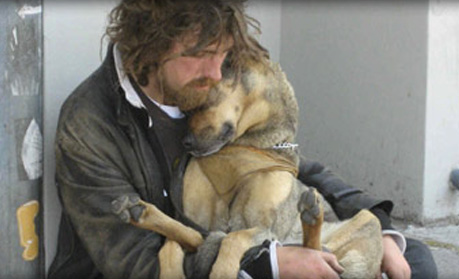
With groundbreaking numbers of homeless people living in New York City, it is hard to believe that the homeless burden themselves with the ownership of an animal. However, in many cases, the homeless community finds solace, protection, and companionship through their pets. By caring for their furry, four-legged friend, many homeless people sacrifice their own starvation and habitation for their dogs or cats.

Throughout New York City, a majority of homeless shelters do not allow pets. As a result, these homeless shelters reject hundreds of homeless people and their pets each night.

Photo Courtesy // Pets of the Homeless Organization

Currently, there is only one shelter available for the homeless and their pets. In May 2013, the Mayor’s Alliance partnered with Urban Resource Institute and its People and Animals Living Safely (URIPALS) pilot programs to provide co-sheltering for families and their pets. The PALS programs specifically works with victims of domestic violence, in an effort to provide “essential support in the form of crucial expertise and technical assistance by addressing the link between animal welfare and human welfare.” The Mayor’s Alliance and the Urban Resource Institute are “seeking funds and resources to equip its facility to accept dogs and expand the program to other shelters.”

In an effort to change the harsh reality for homeless people and their pets, the nonprofit organization Pets of the Homeless provides pet food and veterinary care to the homeless living in New York City and across the United States. Pets of the Homeless’s mission is to “feed and provide basic emergency veterinary care” to homeless people’s pets, thus relieving the “anguish and anxiety of the homeless who cannot provide for their pets.”

Throughout New York City, there are 11 donation sites that collect pet food and pet supplies for those in need. By working with distributing organizations, such as local food banks, pantries, soup kitchens and homeless shelters, these collection sites provide the necessary resources and services for homeless people and their furry companions.

Hundreds of homeless people with pets in New York City struggle to provide for themselves and their beloved animals. Through nonprofit organizations like Pets of the Homeless and shelters like URIPALS, humans and animals are given a second chance in life.

The Price of Being Sick: How One East Harlem Vet Clinic Strives to Charge Less and Help More

“I knew a man that lived right on the corner of 116th and First Avenue that had to go to the bank around the corner to take out a $10,000 dollar loan just to cover his dog’s vet bill one year,” East Harlem pet shop and veterinary clinic owner Joseph Spataro recalled. “It just breaks your heart. That dog was his everything. And the vet screwed him over for all his money.”

For many dog owners, the greatest doggy burden on their bank accounts are regular veterinary office visits that can cost anywhere from $82 to $165 dollars. Many people believe they are getting a discounted price at places like PetSmart and ASPCA but end up paying hundreds more than they expected and have to return for costly follow-up visits, said Spataro.

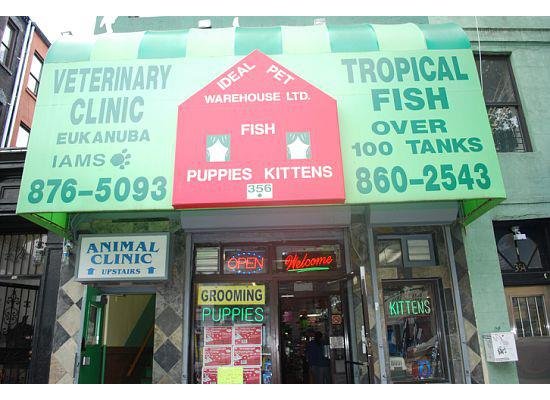
Spataro’s love for animals and love for his East Harlem neighbor’s prompted him to open up a veterinary clinic atop his pet shop, 15 years ago. Located on 116th Street between First and Second Avenues, Ideal Pet Veterinary Clinic provides veterinary medical services for only $35 dollars.

Embedded within the heart of El Barrio, Ideal Veterinary Clinic opens its doors four times a week to the residents of East Harlem and surrounding neighborhoods. From ear and eye infections to vaccinations to micro chipping, Spataro’s veterinary clinic accepts all customers at a small price.

Photo// Charlotte Gibson

“We don’t want people to have to worry about taking out loans for their animals just to cover their medical expenses,” said Spataro. “We care about the dogs and we will charge you what’s right.”

Currently, the median household income in East Harlem is approximately $31,444 dollars, according to the U.S. Census Bureau. Many East Harlemites live paycheck-to-paycheck and struggle to pay the rent each month, which makes owning a dog extremely burdensome on their livelihood.

For East Harlem pet owners Mary Ann and John DiSalvio, affordable veterinary clinics like Ideal Pet Veterinary Clinic are necessary for caring their pets and their bank accounts. Without affordable veterinary options, the couple said they wouldn’t be able to properly care for their dogs’ needs.

“We love them and we’d do whatever we had to for them, but it’s too expensive. There has to be more options out there. More doctors have to participate in helping the situation like Ideal,” John DiSalvio said.